The History of Como: From Roman Novum Comum to the City of Silk
Before it was a postcard on the lake, Como was a Roman colony, a rebellious free city, a workshop of master stonemasons and, for nearly two centuries, the silk capital of Italy. Its story runs through Julius Caesar, two of the greatest writers of antiquity, a decade-long war with Milan and some of the finest churches in northern Italy. Here is a readable account of how the city became the one you walk today — and why its living tradition, the one at the table, is better learned with your hands in the dough than behind museum glass.
Novum Comum: Julius Caesar’s city
A settlement stood at the tip of the lake’s western branch well before the Romans, tied to the Golasecca culture and later the Gauls. But it was the Romans who gave it an urban shape. In 59 BC, Julius Caesar re-founded the town as Novum Comum, a planned colony laid out on the classic grid: that regular pattern of streets still defines the walled historic centre today. Walk inside the old town and you are, in effect, walking the Roman plan.
The location was no accident. Como sat on a route toward the Alpine passes, with the lake as a watery highway to the north. Trade, exchange, transit: the city’s merchant DNA is as old as its walls.
The two Plinys, sons of Como
Few places can claim two such important authors born among their houses. Pliny the Elder (AD 23/24–79), naturalist and author of the monumental Natural History, died observing the eruption of Vesuvius too closely. His nephew and adopted son, Pliny the Younger, left us letters that remain a precious window onto the Roman world — including the famous pages on the AD 79 eruption and fond descriptions of his villas on Lake Larius. Como honours them with pride: their statues keep watch over the façade of the Duomo, a rare case of pagan writers set on a Christian cathedral.
The free comune and the war with Milan
After the empire fell, Como passed through Lombards and Franks, but the turning point came in the Middle Ages, when it became a free comune: a self-governing city-state. Civic pride brought it to blows with its powerful neighbour. The Ten Years’ War (1118–1127) pitted Como against Milan for control of trade on the lake; the city was eventually defeated and largely destroyed. In revenge, Como later sided with Emperor Frederick Barbarossa against Milan.
Those events left tangible marks: the medieval towers and gates, such as the Porta Torre, still guard the entrance to the walled town. It is history you can touch on a walk.
The Maestri Comacini and Romanesque stone
From Como’s territory and the nearby lakes came a guild of builders and stonecutters legendary in the Middle Ages: the Maestri Comacini. Itinerant architects and masons, they worked across half of Europe and carried their mastery of stone wherever they went. Their masterpiece in Como is the Basilica di Sant’Abbondio, an eleventh-century Romanesque jewel with five naves, consecrated in 1095: austere, soaring, with twin bell towers and a cycle of fourteenth-century frescoes in the apse. It sits off the tourist flow, which is exactly why it rewards the detour.
- Sant’Abbondio — pure eleventh-century Romanesque, five naves, medieval frescoes.
- Basilica di San Fedele — in the heart of the centre, on a square that was the Roman forum and still holds the market.
- Porta Torre and the walls — the medieval ring that encloses the Roman plan.
- The Maestri Comacini — the school of masons that exported Romanesque across Europe.
The Duomo: five centuries in one façade
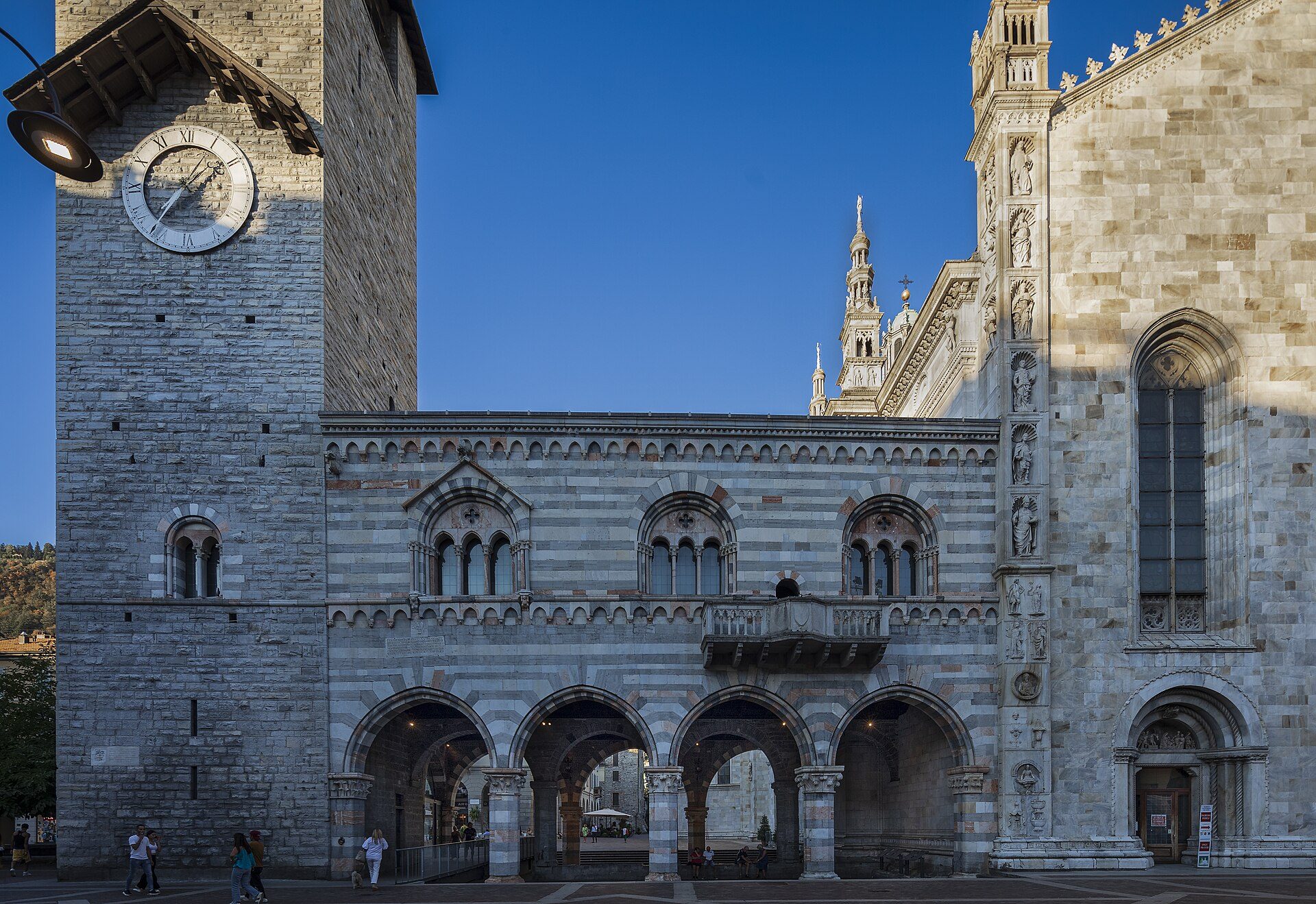
The Como Cathedral (Duomo), dedicated to Santa Maria Assunta, is one of the few buildings where you can read the shift from Gothic to Renaissance in a single glance. Construction began in the late fourteenth century and continued for centuries: the façade is late Gothic, finely carved; the flanks and interior turn Renaissance; and the great eighteenth-century dome, by Filippo Juvarra, crowns the whole. Don’t miss the tapestries inside, and the two Plinys on the façade. The striped medieval Broletto in white, grey and pink, beside the Duomo, completes one of the loveliest squares on the lake.
The city of silk
The last great transformation belongs to the nineteenth century. Silk-working had been growing in town since the 1700s; in the 1800s it became Como’s economic engine, and the city established itself as the silk capital of Italy. Spinning mills, weavers and dye works supported generations and supplied fine fabrics to fashion houses around the world — a primacy still largely alive today. To this era we owe the Silk Museum (Museo della Seta), where machinery, looms and sample books tell the trade. Silk also explains the city’s slightly refined elegance: Como has always been a place of artisans and taste.
Key takeaways
- 59 BC: Julius Caesar re-founds the town as Novum Comum, on the grid that is still the historic centre.
- Como is the birthplace of Pliny the Elder and Pliny the Younger, honoured on the Duomo’s façade.
- A medieval free comune, it fought the Ten Years’ War with Milan (1118–1127).
- The Maestri Comacini and the Basilica di Sant’Abbondio (1095) define its Romanesque age.
- The Duomo blends late Gothic and Renaissance; the 1800s make Como the city of silk.
A tradition you learn by hand
There is one story no museum keeps under glass: that of the kitchen. Pasta rolled by hand with a pin, the aperitivo as a social rite, gelato as a small everyday luxury — these are living traditions, passed on by doing. That is exactly what we offer in our cooking class in Como: three hours, a short walk from the Roman historic centre, where you learn to roll the sfoglia the way it has been made for generations. Our chef trained at Rina Poletti’s Accademia della Sfoglia, a guardian of this technique.
The class also includes a spritz lesson — you build your own Aperol or Campari spritz and enjoy it as your aperitivo — and ends with gelato topped with a few drops of Traditional Balsamic of Modena DOP. To understand the ritual better, read our piece on the best aperitivo in Como; and if you want a full day of history and food, look at our things to do in Como for food lovers.
Taste the history of Como at the table
A hands-on cooking class a short walk from the Roman centre: hand-rolled pasta, a spritz lesson and gelato with balsamic DOP — all in one evening.
Book a class Back to Journal