Saffron and Risotto alla Milanese: A Golden Story
Risotto alla milanese is one of the few dishes in the world you recognise with your eyes before your nose: a warm, almost metallic yellow that has kept historians and cooks arguing for four and a half centuries. Legend has it born high up, on a scaffold of the Duomo di Milano, among the coloured glass of a Flemish apprentice. From there the story drops down into the flooded fields of the plain, passes through a ladle of broth and a knob of cold butter, and reaches Lake Como — where that gold, today, is learned by hand.
Milan, 1574: the legend of the glassmaker
In the sixteenth century the Flemish master Valerio di Fiandra was at work on the stained-glass windows of the Duomo. Legend says his apprentice had an obsession: he added saffron to his pigments to make the yellows of the windows glow — so insistently that his workmates nicknamed him “Zafferano” and teased him: one day you will put it in the rice too. In September 1574, at the wedding of the master’s daughter, the joke became a dish: the rice at the banquet arrived at the table golden yellow. The guests, somewhere between shock and delight, finished it to the last grain.
The legend is too good to demand evidence for, but it tells one true thing: in the Renaissance, gold on the table was a sign of power — at the richest banquets, dishes really were gilded with gold leaf — and saffron was edible gold, the way to bring that light onto the plate. So the colour is born there. The technique is not: toasting the rice, adding broth one ladle at a time and the mantecatura are children of the Milanese cookbooks of the nineteenth century, when the festive “yellow rice” became the risotto alla milanese we know.
Threads or powder?
Saffron is the flower of Crocus sativus: each bloom gives just three red stigmas — the threads, or pistilli as Italian cooks call them — picked by hand at dawn, before the sun can spoil them. It takes around 150 flowers for a single gram: that is why it is the most expensive spice in the world. Whole threads are an identity card you can read at a glance: you can see them, count them, and they cannot be faked. Powder is convenient and dissolves quickly, but it is also the easiest form to stretch with something else: buy it only from someone who has earned your trust. For risotto we side with the threads — they ask for only one thing in return: time.
Why saffron steeps in the broth
Saffron’s colour and perfume — crocin and safranal, for those who like the names — are not released on contact: they dissolve slowly, in warm liquid. Tossing the threads into the rice at the last minute gives you pale yellow streaks and a mute aroma. The right move is different: drop the threads into a cup with a ladle of warm broth at the start of cooking and forget them there while you do everything else. When the broth has turned a deep orange, pour it into the rice towards the end of cooking: saffron’s perfume does not survive long simmering — this way the gold comes out even, and the aroma is still there.
The mantecatura: the final wave
Risotto is not finished on the heat: it is finished off the heat. Cold butter in pieces, grated Parmigiano, and you beat it with energy — mantecare, Italians say — until the fat binds the starch and the cream appears. Proper risotto is “all’onda”: tilt the plate and it should move like a slow wave. If it sits still, it is already too dry.
A chequerboard sea: Lombardy and its rice
If the gold came from far away — saffron travelled for centuries with Mediterranean merchants — rice in Milan is at home: it has been grown in the plain south of the city since the late fifteenth century, in the days of the Sforza. The land between Lomellina, Pavia and Novara still produces much of Europe’s rice, and in spring the flooded paddies look like a chequerboard sea reflecting the sky. From those fields comes Carnaroli, the king of risotto rice: it holds its bite and gives up just the right starch — the kind that, at the mantecatura, turns into a wave.
And Como? The lake, and the class a few steps away
Milan to the lake is barely an hour, and the gold soon travelled up the road to the lakes. Como, after all, has an old familiarity with golden threads — here they were woven into silk for half the world — and risotto has always been at home on lake tables, alongside missoltini and polenta: we cover it in our guide to the traditional dishes of Lake Como. And if you would rather learn risotto alla milanese than merely order it, our kitchen is in the centre of Como.
Key takeaways
- 1574: the legend of the Duomo glassmaker and the golden wedding rice.
- Risotto proper arrives with the Milanese cookbooks of the 1800s.
- Whole threads = quality you can see; powder only from trusted suppliers.
- Saffron steeps in warm broth and goes in towards the end of cooking.
- Mantecatura off the heat: cold butter, Parmigiano, a plate “all’onda”.
Learn the gold with your own hands
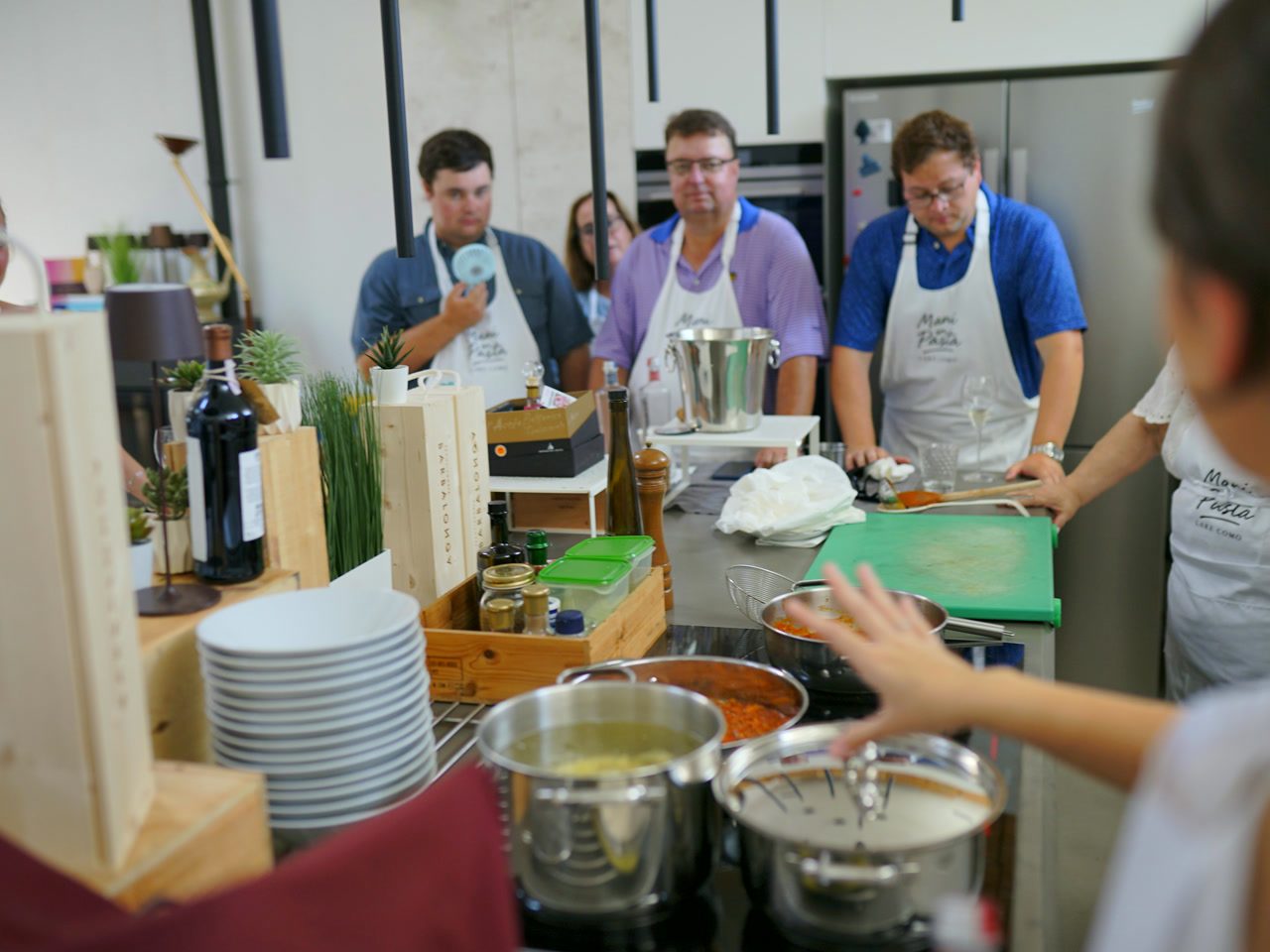
In our Risotto Masterclass, the Saffron Risotto (€130 per person) retraces exactly this story: toasting the Carnaroli, broth one ladle at a time, saffron left to steep and the mantecatura off the heat. There is also the Luganega Risotto (€140): the same saffron risotto with luganega, the fresh pork sausage of Lombardy. It ends the way the 1574 banquet did: seated at the table, in front of a plate the colour of gold.
Risotto Masterclass in Como
Saffron Risotto €130 per person, or Luganega Risotto (pork sausage) €140: toasting, broth, saffron infusion and the mantecatura all’onda. Included: an aperitivo with cured meats and cheeses, local wine at the table (one bottle for every four guests) and artisan gelato with 25-year-aged Traditional Balsamic Vinegar of Modena DOP.
Discover the Risotto Masterclass Back to Journal