
Como Cathedral and the Old Town: A Walking Guide
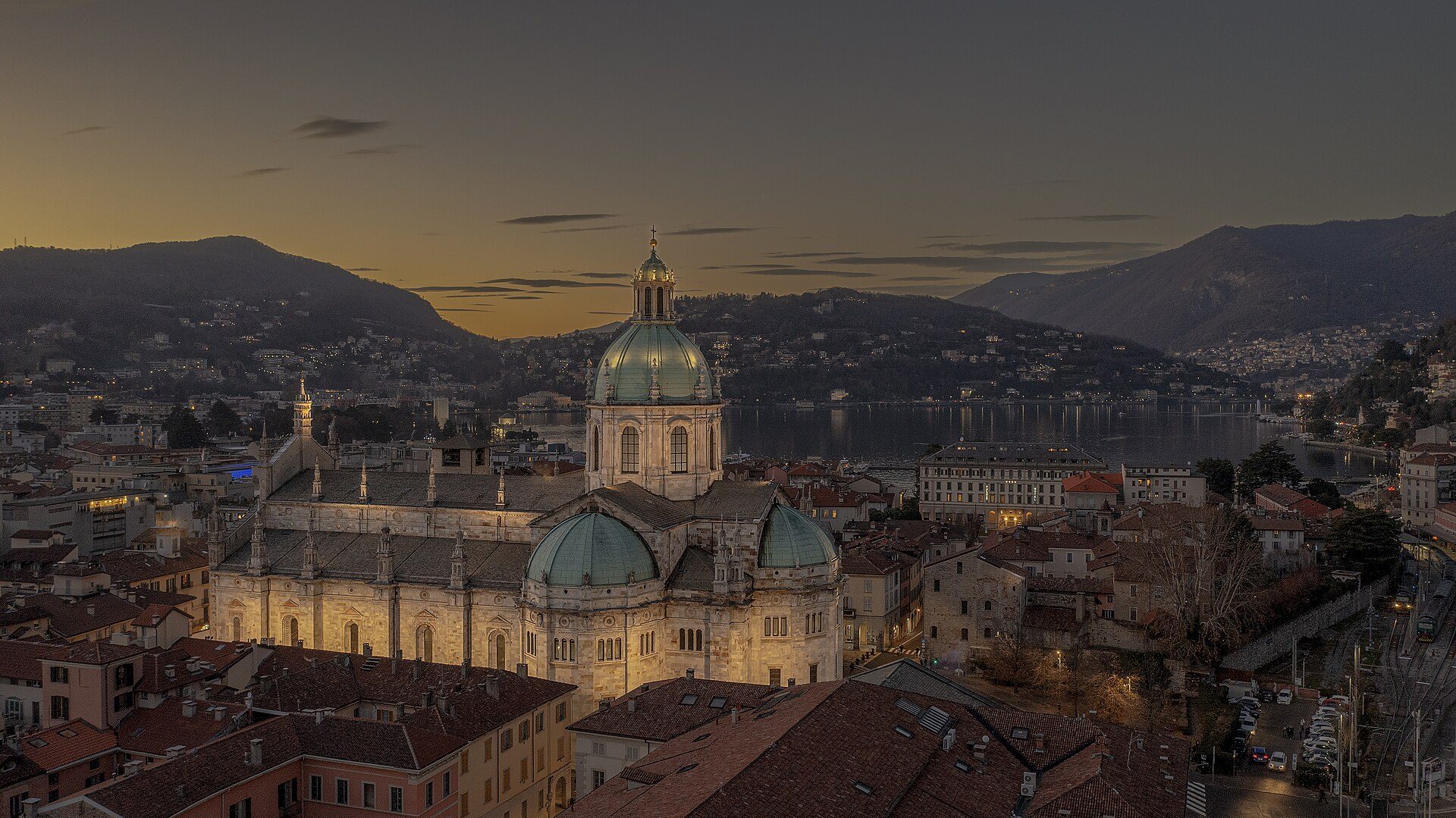
Como’s centre is small, walkable and surprisingly layered: in a few blocks you move from Roman walls to Gothic, from Renaissance to Baroque. The heart of it is the Cattedrale di Santa Maria Assunta — the Duomo — built over centuries and crowned by an 18th-century Rococo dome attributed to Filippo Juvarra. This is a short loop on foot — the cathedral, the Broletto, the Basilica di San Fedele, the Porta Torre and the surviving medieval walls — for anyone who likes to read a city by walking it. It is also, conveniently, the neighbourhood a few minutes’ walk from our cooking class in Como.
The Duomo: five centuries in one façade
Como Cathedral is one of those rare buildings that show, in a single elevation, the move from one age to the next. Work began in the late 14th century, in full Gothic, and carried on for roughly four hundred years: the marble façade, with its great rose window and statues, was finished in the 15th century, but the body of the church and the transept arms are already Renaissance. Walking in and out, you sense that drift of styles — pointed arches low down, calmer and more classical lines as the building rises.
One detail many visitors don’t expect: flanking the main portal stand statues of Pliny the Elder and Pliny the Younger, two Roman authors who came from Como. A Christian cathedral that honours two pagan writers on its own front says a great deal about this city’s civic pride. Give it a minute on the square before you go in — the façade reads best from a few steps back.
Juvarra’s dome
For most of its history the Duomo stood open above the crossing. The dome was only added in 1744, to a design by the architect Filippo Juvarra, one of the leading figures of the late Baroque and Rococo in Italy. Seen from outside — especially as you climb toward Brunate or look back from the lake — it is the shape that signs Como’s skyline. Seen from inside, it closes the space with a lightness the Gothic alone would never have given it.
That contrast is exactly what makes the Duomo so instructive: a Gothic structure, Renaissance ornament and an 18th-century dome, all held together without a single jarring note. Entry is free; you are simply asked to dress respectfully (shoulders and knees covered) and to keep quiet, as it is a working church. Hours shift around services, so it is worth checking the official opening times for the day.
The Broletto and San Fedele
Built right against the flank of the Duomo is the Broletto, the old medieval town hall, easy to spot by its bands of white, grey and pink marble and the balcony from which public proclamations were once read. It is worth noting how the cathedral and the Broletto almost touch: the Church and civic power, side by side, as was normal in the free communes of Lombardy.
A few minutes away, through the lanes, you reach the Basilica di San Fedele. It is far older than the Duomo — Romanesque in feel, set on a small square ringed by timber-framed houses that is one of the most photographed corners of town. Look, at the back, for the Romanesque portal with its carved reliefs: it is one of Como’s most precious medieval survivals.
- Duomo — Gothic, Renaissance and Juvarra’s Rococo dome, all in one building.
- Broletto — the marble-banded medieval town hall, right beside the cathedral.
- San Fedele — a Romanesque basilica on a square of timber-framed houses.
- Porta Torre — the 12th-century gate-tower, the monumental entrance to the walled town.
The Porta Torre and the medieval walls
Away from the lake, on the landward side, the old town is still ringed by stretches of medieval wall. The grandest gate is the Porta Torre, a 12th-century tower some forty metres high, raised when Como rebuilt its defences after the wars with Milan. Together with the Torre Gattoni and other remnants, it marks the edge of the walled town. Walking through it is the simplest way to grasp where medieval Como ended and the countryside began.
From here, turning back toward the lake, the whole old town lies in front of you: the same regular grid of streets inherited from the Roman camp, still legible beneath the shop signs.
A walking loop (and where to pause)
A simple circuit: start from the lakefront and Piazza Cavour, climb to Piazza del Duomo for the cathedral and the Broletto, thread the lanes to San Fedele, carry on to the Porta Torre and the walls, then drop back toward the lake. It is a one- to two-hour loop depending on how long you linger, all flat and pedestrianised. To widen it with food stops, see our guide to things to do in Como for food lovers.
For breaks: around the Duomo and through the lanes there are plenty of historic cafés and aperitivo bars. We won’t hand out names and hours — those change — but the advice is to look for the places with tables out on the inner squares, order a coffee at the counter mid-morning or a spritz at sunset, and check current reviews. On the ritual itself we have written a dedicated guide to aperitivo in Como.
Key takeaways
- Como’s Duomo blends Gothic, Renaissance and a 1744 Rococo dome by Juvarra.
- On the façade, beside the portal, stand statues of Pliny the Elder and the Younger.
- Right against the cathedral: the marble-banded medieval Broletto.
- A little beyond: the Romanesque Basilica di San Fedele and the 12th-century Porta Torre.
- A 1–2 hour walking loop, all flat; always check official hours and current reviews.
From the square to the stove
Our studio is a few minutes’ walk from the old town, so you can see the Duomo in the afternoon and then join us for the evening. The class runs about 3 hours, in small groups of up to 12, in English and French, and includes the hand-rolled-pasta masterclass, a spritz lesson — you build your own Aperol or Campari spritz and enjoy it as your aperitivo — the meal you cook with wine, and gelato topped with a few drops of Traditional Balsamic of Modena DOP. See how it works, or choose from the four masterclasses: Tagliatelle – Fresh Tomato, Tagliatelle – Ragù Bolognese, Ravioloni Verdi – Ricotta and Farfalle & Garganelli – Ragù.
After the walk, into the kitchen
€150 per person, ~3 hours, minutes from the Duomo: hand-rolled pasta, a spritz lesson and gelato with balsamic DOP.
Book a class Back to Journal